Sunni, Shia, and the Pitch: How 90 Minutes Together Rewrites Old Stories
We should say the uncomfortable thing first. Muslim community-building efforts in North America rarely integrate Sunnis and Shias. They coexist, often in the same neighbourhood, sometimes within walking distance of each other's mosques, and they do a lot of parallel work, parallel Sunday schools, parallel food drives, parallel conferences, without ever quite meeting in the middle. Nobody plans it this way. It's just what happens when institutions form around doctrine and historical memory. Parents who would happily break bread with their neighbours find themselves, twenty years into living on the same street, still uncertain how their kids should interact with the kids across the way.
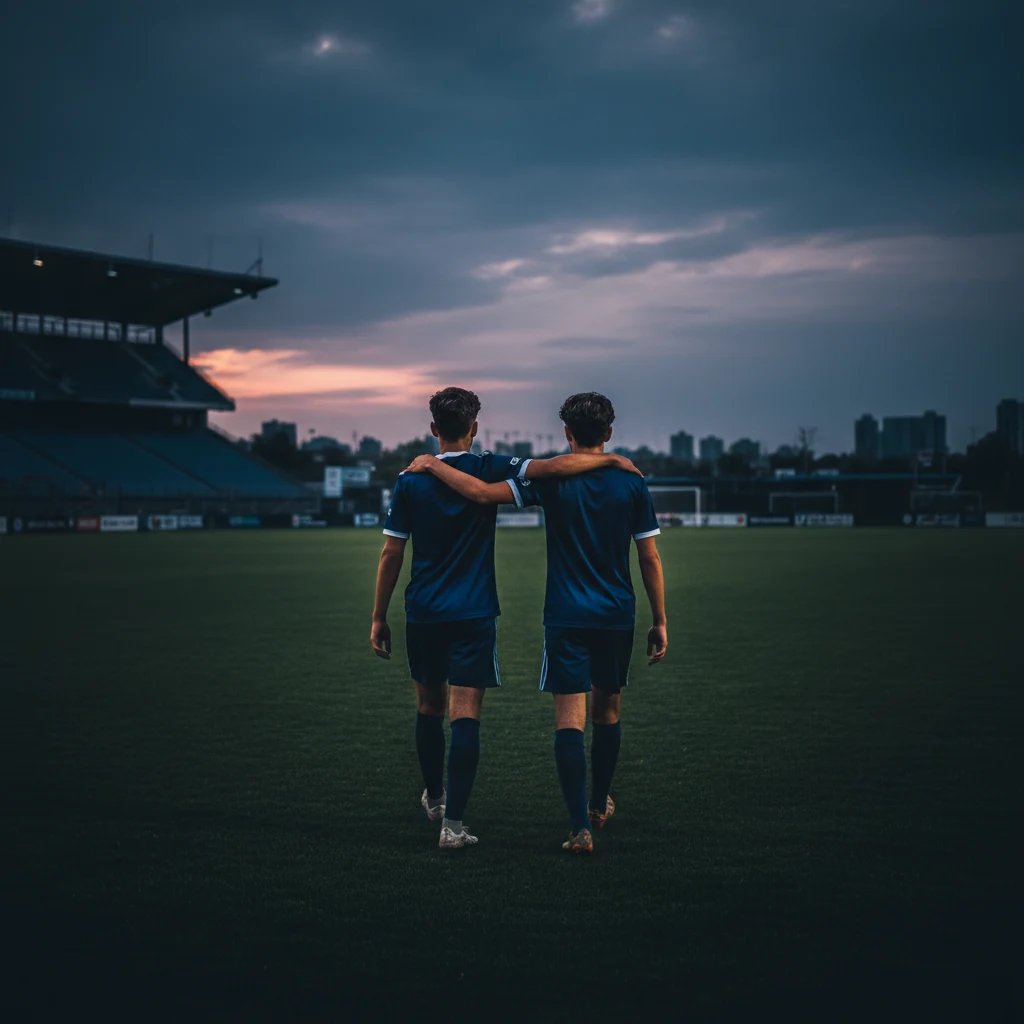
We built Muslim Youths FC knowing this. And one of the small, unreported things that happened almost immediately after year one began was that kids from Sunni and Shia families started passing to each other, getting yelled at by the same coaches, and celebrating the same goals. They didn't ask permission. They just did what ten-year-olds do when you put them on the same side of a field and give them jerseys of the same colour.
The kids don't ask
Here is the single most important observation we've made in two years of running this league: the kids don't ask. They don't ask who prays which way. They don't ask whose holidays fall on which dates. They don't ask whether the name of the kid next to them signals one tradition or another. They ask the things kids always ask in any community sports program: can you pass, are you fast, do you know the kid from Queen Mary School, is it your turn in the goal?
For the first two weeks of year one, we held our breath. We'd seen enough well-intentioned ventures founder on a question a parent asked an organiser, and we expected some version of is this a Sunni league or a Shia league? It didn't come. What came instead was a father asking if we had a cooler big enough for the entire team to share, and a mother asking whether her daughter could wear a hijab in the goalkeeper gloves (of course she can). Nobody asked what we were afraid they would ask.
The sectarian question never showed up because it didn't survive contact with the scheduling spreadsheet. Coaches are assigned by experience, not theology. Teams are balanced by age and skill, not by mosque. The coin toss at the start of the match is random. The whistle doesn't know who you are. And by the time anyone might have thought to raise a flag, two kids from different traditions were already passing to each other with more trust than they'd built with anyone outside their own school in three years of classroom life.
Why sport succeeds where panels fail
Every major North American Muslim organisation, at some point, has held a "Muslim unity" panel. They're well-meaning and they're usually ineffective. Not because the speakers are wrong, the speakers are almost always right, but because a panel is structured as a performance for an audience. The audience claps. Then everyone goes home and resumes the lives they lived before.
A panel is vertical. The speakers speak; the audience listens. It's a form well-suited to teaching history or theology, and it's badly mis-matched to the actual task of unity, which is relational. Unity doesn't happen in a sentence. It happens in the ten thousand small choices two people make when they're forced to share a task over time. Passing, marking, cheering, bench-warming. The things that make up a soccer match.
This is the reason we keep saying, in every conversation we have with parents and imams and funders, that soccer is the language of Muslim community. Not a metaphor. A literal claim. The sport itself does the sectarian integration work that no panel in North America has ever managed to accomplish in one generation.
What the adults see, and what they learn
Kids figure this out fast. Adults, it turns out, have a harder time. And that's where the sideline comes in.
Every Monday evening from June to August, parents from two traditions end up standing within ten feet of each other, watching their children cooperate on a field, with nothing to do for two hours except watch and talk. The first week, they don't talk much. They exchange polite nods. By week three, they're passing snacks. By week six, they're arranging carpools. By the end of a season, they're on each other's WhatsApp threads, sending congratulations when a cousin gets married, asking which pediatrician to see when a kid has a cough.
That is not a small thing. That is how communities that have been parallel for thirty years finally start to knit. And what made it possible wasn't a grand gesture. It was a scheduling decision: put the teams together, don't filter, and let the ball do the rest.
The thing nobody has to say out loud
We have never, in two years of running MYFC, made a public statement about sectarian unity. We don't put it in our marketing. We don't mention it at opening ceremonies. We don't run "unity matches" or "bridge-building events" or any of the well-intentioned adult signalling that almost always backfires with the people it's supposed to reach.
The reason is simple: the moment you announce the goal, you reintroduce the very categories you're trying to dissolve. A kid who's never thought about the word Shia or Sunni in their life suddenly has it pointed out to them, and the whole point, the fact that the category was already dissolving on its own through the act of play, is lost.
So we keep our mouths shut and run the league. Kids pass to each other. Parents carpool. A family from one tradition invites a family from the other over for iftar because their kids played defence together and wouldn't stop talking about it on the car ride home. The ummah, in the active sense of the word, builds itself.
What we want Muslim parents to know
If you've been waiting for the right kind of community space for your kid, one where the doctrinal lines of your own childhood don't predetermine who their friends are, sport is your answer. Not because sport is neutral (it isn't) but because sport is generative. It creates relationships that wouldn't exist otherwise and then makes those relationships the new default.
Drop your kid off at BGT Field on a Monday night in June. They'll come home with the name of a kid whose family you've never met. Over a summer, those names turn into something real. Over a few summers, they turn into the kind of community our parents' generation assumed we would have to build from scratch.
We didn't build it from scratch. The kids built it. We just had to stop getting in their way.